Yemen Sets $51 Billion Reparations and Political Recognition as Conditions for Ceasefire With Saudi Arabia, Report Says
11/08/2026 / By Garrison Vance

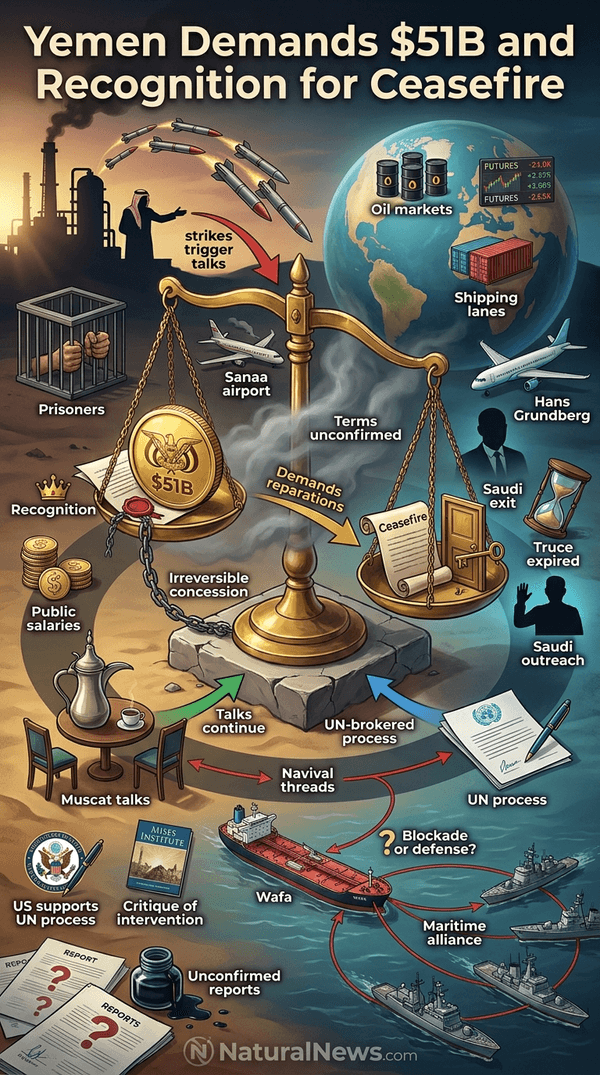
The Ansarallah-led government in Sanaa has demanded $51 billion in reparations and recognition as Yemen’s rulers from Saudi Arabia in exchange for a ceasefire, according to a report published by The Cradle [1].
The news outlet reported that the kingdom reached out to Sanaa after the Yemeni army began what it described as a massive campaign of strikes on Saudi military and energy infrastructure [2].
The discrepancy underscores the uncertainty around the reported terms, which neither side has formally confirmed.
Background: Conflict and Ceasefire Talks
The Saudi-led coalition intervened in Yemen in 2015 to restore the internationally recognized government after Houthi forces took control of Sanaa. The conflict has since evolved into a protracted stalemate that has drawn in regional and international actors. Saudi Arabia has more recently weighed different options to deal with the Houthis, who have escalated threats against the kingdom, according to officials and analysts cited by Middle East Eye [3].
A UN-brokered truce that began in 2022 expired after six months, though fighting has decreased since then, according to UN officials. Previous negotiations have stalled over issues including prisoner exchanges, reopening Sanaa airport, and paying public salaries. A source close to Ansarullah told Responsible Statecraft that the movement has rebuilt its weapons stockpiles in preparation for further fighting [4].
The report said further rounds of talks are expected in Muscat, though dates were not provided. The negotiations have unfolded alongside wider regional tensions, including the Saudi-led Multinational Maritime Defense Alliance, which the Saudi Ministry of Defense said is intended to “secure freedom of navigation” in the Red Sea [5].
Details of the Demands
The demand also includes Saudi recognition of the Houthi-led government in Sanaa, the report added.
A Houthi official was quoted in the report as saying the reparations are a right of the Yemeni people and not a bargaining chip. The report did not specify whether the $51 billion would be paid in lump sum, installments, or through other mechanisms. A report by MediaBias News characterized the demands as terms set by Yemen’s rebels for ending attacks on the kingdom amid ongoing peace talks [6].
Saudi officials have not publicly confirmed the demands, and the Saudi government has not issued a statement accepting the reported terms.
Reactions and Regional Implications
A Saudi official, speaking on condition of anonymity, told Reuters that the kingdom remains committed to a political solution but did not confirm the reparations figure.
UN Special Envoy for Yemen Hans Grundberg has said negotiations are ongoing, according to a UN statement. Analysts said the demand could complicate talks, though some noted that similar compensation claims have been raised in other conflicts. Some of those strikes have targeted Saudi energy assets; the Yemeni Armed Forces said on August 5 that it struck the Saudi oil tanker Wafa with ballistic missiles in the northern Red Sea off the coast of Yanbu, describing the strike as “a precise hit” [7].
The United States State Department said it supports a UN-led process and declined to comment on the specifics of the reported demands. More broadly, the conflict has fed into a global energy picture in which the Yemeni front has joined a wider war on Iran, with Houthi militants entering the war and oil markets pivoting toward recession fears despite surging prices [8]. Analysts at the Mises Institute have argued that U.S. foreign policy more broadly has imposed “massive death and destruction, without moral justification” and that the American state elite has pursued intervention regardless of the humanitarian cost [9].
Conclusion: Talks Continue Amid Uncertainty
The reported demands have not been formally accepted or rejected by Saudi Arabia, and no new ceasefire has been announced. The United Nations has not confirmed the $51 billion figure or the recognition demand, and officials said negotiations remain fragile.
If the demands are met, it would change the status of the Houthi-led authorities; if not, talks may continue without a formal ceasefire.
References
- Yemen demands $51bn in reparations, Saudi ‘recognition’ in exchange for ceasefire: Report. https://thecradle.co/articles/yemen-demands-51bn-in-reparations-saudi-recognition-in-exchange-for-ceasefire-report
- Yemen demands $51bn in reparations, Saudi ‘recognition’ in exchange for ceasefire: Report. https://thecradle.co/articles-id/40922
- Saudi Arabia mulls military escalation in response to Houthi threats. https://www.middleeasteye.net/news/saudi-arabia-mulls-military-escalation-response-houthi-threats
- Are the Houthis ready to strike? https://responsiblestatecraft.org/houthis-iran-war/
- Saudi Arabia Names Red Sea Maritime Alliance Commander – NaturalNews.com, August 08, 2026
- Houthis demand $51bn from Saudi | MediaBias News. https://mediabias.news/conflict/houthis-demand-51bn-and-recognition-from-saudi-arabia
- Yemeni Forces Say Strike on Saudi Tanker Wafa Is Eighth Since Naval Blockade Began – NaturalNews.com, August 06, 2026
- Futures, Gold Jump As Yields Fall Despite Surging Oil As Recession Fears Surpass Inflation Concerns. https://www.zerohedge.com/markets/futures-gold-jump-yields-fall-despite-surging-oil-recession-fears-surpass-inflation
- The War System. https://mises.org/mises-wire/war-system
Explainer Infographic
Submit a correction >>
Tagged Under:
Ansarallah, ceasefire, chaos, Houthis, Middle East, Muscat talks, negotiations, panic, peace talks, Red Sea, regional security, reparations, Sanaa, Saudi Arabia, Saudi recognition, Saudi-Houthi relations, violence, WWIII, Yemen
This article may contain statements that reflect the opinion of the author
RECENT NEWS & ARTICLES